ACFT Score Calculator — Get Your Result in Seconds
Free Army Combat Fitness Test Calculator | Accurate Scoring for All 6 Events
Based on 2026 ACFT Standards
The free ACFT Score Calculator applies official 2026 Army standards — adjusted for your age and gender — across all 6 events, and shows your result in seconds.
ACFT Score Calculator — 2026 Standards
Select your gender and age group, then enter your result for each of the 6 events. Your score is calculated instantly.
The ACFT is the U.S. Army's official fitness test (effective April 2024), scored across 6 events with age- and gender-specific standards sourced from FM 7-22.
The Six Army Combat Fitness Test Events Explained
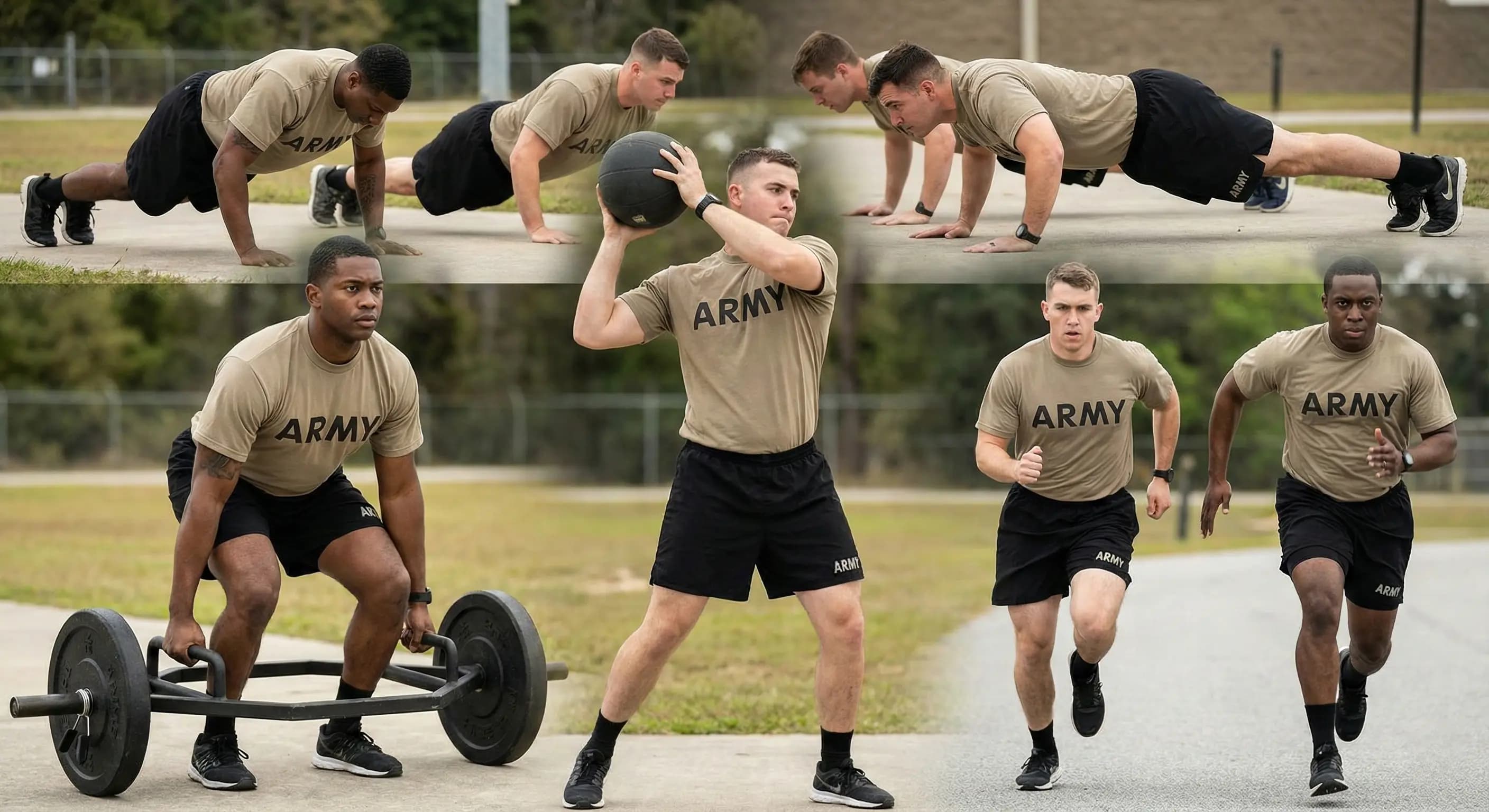
Event 1: 3-Repetition Maximum Deadlift (MDL)
What It Tests: Maximum muscular strength, primarily targeting the lower body, back, grip strength, and core stability.
How It's Performed: Soldiers execute three consecutive deadlifts using a hex bar loaded with maximum weight they can safely lift. The weight ranges from 140 pounds to 340 pounds (or higher for exceptional performers).
Scoring: 60–100 points. Example threshold (male, age 22–26): 140 lbs = 60 pts (Gold min); 220 lbs ≈ 80 pts; 340+ lbs = 100 pts. Grip failure is the most common cause of below-minimum scores.
Event 2: Standing Power Throw (SPT)
What It Tests: Explosive total-body power, coordination, balance, and the ability to generate force rapidly.
How It's Performed: Using a 10-pound medicine ball, soldiers stand with their back to the throwing area and throw the ball backward and overhead for maximum distance.
Scoring: 60–100 points. Example threshold (male, age 22–26): 4.5 m = 60 pts (Gold min); 8.0 m ≈ 80 pts; 12.5+ m = 100 pts. Most soldiers lose points here due to inconsistent hip power, not arm strength.
Event 3: Hand-Release Push-Up–Arm Extension (HRP)
What It Tests: Upper body muscular endurance, core strength, and the ability to repeatedly generate force over time.
How It's Performed: Starting in the front leaning rest position, soldiers lower their bodies until their chests touch the ground, lift their hands completely off the ground, then push back up. Two minutes to complete as many reps as possible.
Scoring: 60–100 points. Example threshold (male, age 22–26): 10 reps = 60 pts (Gold min); 30 reps ≈ 80 pts; 60+ reps = 100 pts. Failing to fully extend the arms on the release is the most penalized form error.
Event 4: Sprint-Drag-Carry (SDC)
What It Tests: Anaerobic endurance, muscular endurance, strength, power, agility, coordination.
How It's Performed: Five 50-meter shuttles: Sprint, sled drag (90 lbs), lateral shuffle, kettlebell carry (2x40 lbs), final sprint.
Scoring: 60–100 points. Example threshold (male, age 22–26): 3:35 = 60 pts (Gold min); 2:20 ≈ 80 pts; sub-1:33 = 100 pts. Most soldiers lose 10+ points on the SDC due to sled drag technique, not cardio — it is the highest variance event on the test.
Event 5: Plank (PLK)
What It Tests: Core strength, core endurance, and the ability to maintain proper body alignment under sustained muscular tension.
How It's Performed: Assume a prone forearm plank position—elbows below shoulders, forearms flat, body forming a straight line. Hold for as long as possible.
Scoring: 60–100 points. Example threshold (male, age 22–26): 2:09 hold = 60 pts (Gold min); 3:00 ≈ 80 pts; 4:20+ = 100 pts. The Plank replaced the Leg Tuck in ACFT 3.0 — it is the most accessible event for older soldiers.
Event 6: Two-Mile Run (2MR)
What It Tests: Aerobic endurance, cardiovascular fitness, and the ability to sustain moderate-to-high intensity effort over time.
How It's Performed: Complete a two-mile run on a measured course. Pacing strategy is crucial.
Scoring: 60–100 points. Example threshold (male, age 22–26): 21:00 = 60 pts (Gold min); 16:00 ≈ 80 pts; sub-13:22 = 100 pts. Along with the MDL, the 2MR represents the highest scoring leverage per event — a 2-minute improvement is often worth 15+ points.
How to Read Your ACFT Score
A total score of 360 is the minimum pass for the Gold (Moderate) standard. Scores above 500 are competitive for promotion points. A perfect score of 600 requires maxing all 6 events (100 points each). Keep in mind: even if your total is above the minimum, a single event below the per-event floor is still a failure.
| Total Score | Performance Level | What It Means |
|---|---|---|
| Below 360 | Failing | Does not meet Gold (Moderate) minimum |
| 360–440 | Minimum Pass | Meets Gold standard; marginal for Gray/Black |
| 441–499 | Solid | Comfortably meets most standards; good baseline |
| 500–539 | Competitive | Earns promotion points; top third of Army performance |
| 540–569 | Excellent | Top 10–15% performance; strong promotion profile |
| 570–600 | Elite | Near-max performance; 600 = perfect score across all 6 events |
Which ACFT Standard Applies to You?
Your required standard is determined by the physical demand category of your MOS — not your personal fitness level. If you're unsure, check AR 350-1 or ask your unit S1.
Minimum Passing Standards by Category
Heavy (Black) Standard
Combat arms & physically demanding MOSs
- ✓ Total: 440+ points
- ✓ Per event: 70+ points
- ✓ Cannot fail any event
Examples: 11B Infantry, 18X SF, 19K Armor, 13F Fire Support
Significant (Gray) Standard
Combat support & technical specialties
- ✓ Total: 440+ points
- ✓ Per event: 65+ points
- ✓ Cannot fail any event
Examples: 12B Engineer, 31B Military Police, 15T UH-60 Mechanic
Moderate (Gold) Standard
Administrative & support specialties
- ✓ Total: 360+ points
- ✓ Per event: 60+ points
- ✓ Cannot fail any event
Examples: 25U Signal, 42A HR, 68W Medic (non-combat attach.)
ACFT Score Ranges: What Your Score Means
A score above 500 places you in approximately the top third of Army fitness performance and earns promotion points in most competitive boards. A perfect 600 requires maxing every event (100 pts each) — a mark achieved by fewer than 1% of soldiers.
- Below 360: Failing — does not meet Gold minimum
- 360–440: Minimum pass (Gold/Gray/Black depending on per-event thresholds met)
- 441–499: Solid — comfortably above minimum
- 500–539: Very good — competitive for promotion points
- 540–569: Excellent — top-tier, strong career profile
- 570–600: Elite — near-maximum across all 6 events
ACFT vs APFT: Key Differences
The U.S. Army replaced the APFT (Army Physical Fitness Test) with the ACFT beginning April 1, 2024. Below is a side-by-side comparison of the two tests.
| Category | APFT (Old) | ACFT 3.0 (Current) | Why It Changed |
|---|---|---|---|
| Events | 3 (Push-up, Sit-up, 2-Mile Run) | 6 (MDL, SPT, HRP, SDC, PLK, 2MR) | Better reflects combat-task demands |
| Max Score | 300 points | 600 points (100 per event) | More granular performance measurement |
| Age/Gender Scoring | Age-adjusted only | Age & gender-adjusted | Separate tables for male/female per age group |
| Minimum Pass Score | 180 (60 per event) | 360 Gold / 440 Gray & Black | MOS-based physical demand categories |
| Strength Event | None | MDL (max deadlift, 140–340 lbs for males) | APFT had no strength test component |
| Mandatory From | Phased out 2022–2024 | April 1, 2024 | AR 350-1 updated; no APFT exemptions remain |
ACFT Minimum Scores by Age Group
The tables below show the minimum value required to score 60 points (Gold standard floor) on each event by age group. Soldiers 62+ and female soldiers benefit from age- and gender-adjusted thresholds. Note: SDC and time-based events use lower time = better score.
Male — 60-Point Minimum by Age Group
| Age | MDL (lbs) | SPT (m) | HRP (reps) | SDC (max) | PLK (min) | 2MR (max) |
|---|---|---|---|---|---|---|
| 17–21 | 140 | 6.0 | 10 | 2:28 | 1:45 | 22:00 |
| 22–26 | 140 | 6.3 | 10 | 2:31 | 1:40 | 22:00 |
| 32–36 | 140 | 6.5 | 10 | 2:36 | 1:15 | 22:00 |
| 42–46 | 140 | 6.2 | 10 | 2:45 | 1:15 | 22:32 |
| 52–56 | 140 | 5.7 | 10 | 3:00 | 1:15 | 23:20 |
| 62+ | 140 | 4.9 | 10 | 3:16 | 1:15 | 23:36 |
Female — 60-Point Minimum by Age Group
| Age | MDL (lbs) | SPT (m) | HRP (reps) | SDC (max) | PLK (min) | 2MR (max) |
|---|---|---|---|---|---|---|
| 17–21 | 120 | 3.9 | 10 | 3:15 | 1:45 | 23:22 |
| 22–26 | 120 | 4.0 | 10 | 3:15 | 1:40 | 23:15 |
| 32–36 | 120 | 4.1 | 10 | 3:22 | 1:15 | 23:19 |
| 42–46 | 120 | 3.9 | 10 | 3:42 | 1:15 | 23:42 |
| 52–56 | 120 | 3.5 | 10 | 4:03 | 1:15 | 24:24 |
| 62+ | 120 | 3.4 | 10 | 4:48 | 1:15 | 25:00 |
SDC and 2MR columns show maximum allowed time (time-based: lower is better). PLK shows minimum required hold time. Data sourced from FM 7-22 (2026 standards).
Where Soldiers Fail the ACFT — and How to Fix It
Most ACFT failures are caused by technique and pacing errors — not fitness. These are the six most common failure points per event, and the targeted fixes that directly improve your score.
MDL — Grip Failure on Rep 3
Most soldiers generate enough leg drive but lose the bar on the third rep. Train max-grip sets 2–3× per week and use chalk on test day. A double overhand grip holds better than mixed grip for most body types.
SPT — Arms Instead of Hips
Most soldiers throw using arm strength rather than full hip extension. The ball should leave your hands at ~45° overhead with a full forward lean. Train with reverse overhead ball slams to build the hip-drive pattern.
HRP — Incomplete Arm Extension
Graders most often penalize reps where elbows are not fully locked on the upward push. Slow your rep pace by 20% and practice locking out consciously — full extension earns every point you have the muscular endurance for.
SDC — Upright Sled Drag
The SDC is the highest-variance event. Soldiers lose 10+ seconds on the drag by pulling upright instead of leaning back at 45° with short, powerful leg drives. This is a learned motor pattern — drill it specifically before your test.
PLK — Hip Sag or Hip Rise
Graders call failures when hips drop below the straight-line standard or rise into a pike. Both failure modes increase as fatigue sets in. Build plank endurance by training at your target hold time plus 30 seconds — the buffer prevents form breakdown on the actual test.
2MR — Going Out Too Fast
A first mile 15–20 seconds faster than target pace is often unrecoverable. Train with a pace band and aim to hit mile 1 exactly at your target split — a negative split (mile 2 faster than mile 1) is the optimal strategy.
Frequently Asked Questions
Can I fail one event and still pass the ACFT overall?
No. You must meet the per-event minimum for every single event — regardless of your total score. If you score 62 on five events (310 points) but only 59 on the Plank, you fail. Per-event minimums are 60 points (Gold/Moderate), 65 points (Gray/Significant), or 70 points (Black/Heavy) depending on your MOS category.
What is a good ACFT score?
A score above 500 is competitive and typically places you in the upper third of Army fitness performance. Here's a practical breakdown:
- 360–440: Minimum pass (Gold/Gray/Black depending on per-event thresholds)
- 441–499: Solid — meets all standards comfortably
- 500–539: Very good — competitive for promotion points
- 540–569: Excellent — top-tier performance
- 570–600: Elite — near-max scores across the board
What is the difference between the Black, Gray, and Gold ACFT standards?
The three standards correspond to the physical demand level of your MOS. Black (Heavy) applies to combat arms and high-demand specialties — per-event minimum is 70 points, total minimum 440. Gray (Significant) covers combat support roles — per-event minimum 65 points, total minimum 440. Gold (Moderate) covers administrative and support specialties — per-event minimum 60 points, total minimum 360. Your unit S1 or AR 670-1 will confirm your MOS category.
How does the ACFT account for age and gender?
As of ACFT 3.0 (April 2024), scoring tables are age- and gender-specific. Older soldiers and female soldiers have adjusted thresholds for the same point values. For example, a 100-point MDL score requires a heavier lift for a 22-year-old male than for a 45-year-old female. Our calculator automatically applies the correct table based on your selections — no manual lookup required.